Here’s your last look the DL Santa for the year. Don’t miss the party tonight, six to nine, at the 331 Club in Northeast Minneapolis.
And remember that new, unwrapped toy or gift for a needy child for our Toys for Tots collection.
Graphic by Tild
Here’s your last look the DL Santa for the year. Don’t miss the party tonight, six to nine, at the 331 Club in Northeast Minneapolis.
And remember that new, unwrapped toy or gift for a needy child for our Toys for Tots collection.
Graphic by Tild
Sometimes, a callow client will wax eloquent about the competition in the market that her or his business is engaged, as if it was a good thing for the business. When that happens, Spot shakes his head sadly, and then says, “NO YOU FOOL, YOU DO NOT WANT COMPETITION.” Spot adds, “You want your own place in the sun, free from competitive pressures so that you can maximize your profit.” We will, you and I, try to build as many barriers to entry into competition with you as we can.” Patents, trademarks, and making products that are difficult to reverse engineer are just a few things you might try.
A business could also try to limit the availability of labor, capital, or raw materials to the competitor. It could try to sew up exclusive marketing agreement with important distributors. With a formidable adversary, it might be better to just divide up a market and live peace, at least until the business thought it could capture the market at a later time.
The things in the immediately preceding paragraph are, to a greater or lesser extent, illegal under federal and state anti-competition laws. But they are strategies considered for implementation by businesses all the time.
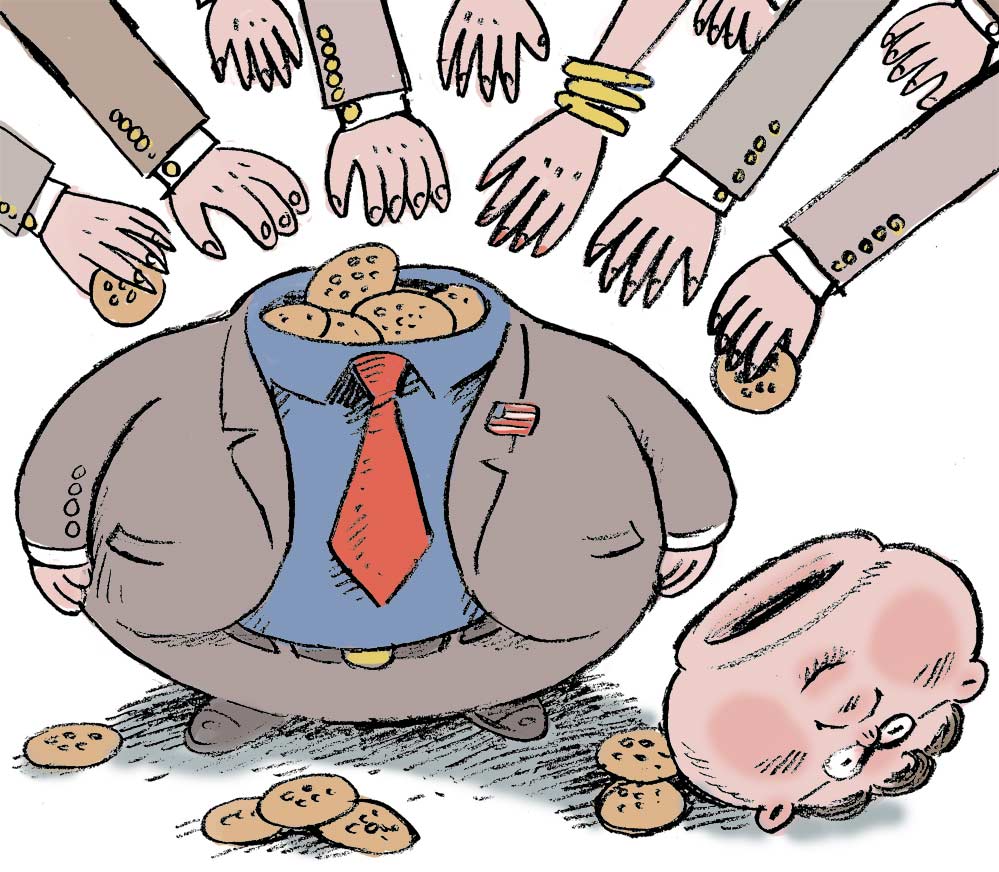
A very powerful trick in building you own place in the sun, if you’re big enough, is called regulatory capture. Think James J. Hill and the Interstate Commerce Commission.
The idea that there is a competitive “private sector” in America is appealing, but generally false. No one hates competition more than the managers of corporations. Competition does not enhance shareholder value, and smart managers know they must forsake whatever personal beliefs they may hold about the redemptive power of creative destruction for the more immediate balm of government intervention. This wisdom is expressed most precisely in an underutilized phrase from economics: regulatory capture.
Regulatory capture is an important feature in the current health care reform debate.
This is why the public option in health care reform is so important. The earnest-looking execs testifying before Congress about the importance of the private marketplace for healthcare are either fools, or much more likely, they think we are. They undoubtedly believe that the people in Congress are.
Because, you see, a viable public option would actually bring the thing the the industry pays lip service to, but hates and fears: competition.
It really is that simple.
They’re leery of so-called performance compensation. Here’s an example of why.
In Edina, the teachers are presently at an impasse with the school board in inking a contract for the period that began last July. There are a few issues in contention, but unsurprisingly, compensation is at the top of the list.
The students in Edina consistently perform at or near the very top of test scores in Minnesota. The district’s voters routinely pass referenda for capital improvements and for operating expenses for the schools. Effortlessly.
You would think that such a high-achieving district with a demonstrated willingness to raise money for its schools would reward its teachers for the kind of achievement that has been wrought.
You’d be dead wrong. Edina ranks 28th in average teacher compensation in the state.
Well, someone might say: of course, the kids are ready to learn; they have affluent and involved parents; the kids get breakfast before coming to school. (Never mind that none of this is universally true, even in Edina.)
All right; let’s accept that premise for a moment. But then the converse has to be true, too, doesn’t it? In other words, teachers from poor districts shouldn’t be the ones held responsible for the socio-economic conditions of their students, as reflected in lower test scores, or for the so-called “achievement gap?”
But obviously, conservatives try to place the blame for students’ poor achievement squarely on the teachers.
It’s a no-win deal for the teachers: great achievement is due to other factors, and poor achievement is the teachers’ fault. This is why teachers’ unions exist.
Spot will come back and fill in some links about test scores and average compensation; that data just isn’t in linkable form to Spot yet.
This is just another friendly reminder of the Drinking Liberally – Twin Cities holiday party this Thursday, December 10th. As we have in past years, we’re doing a Toys for Tots collection. If you can, please bring a new unwrapped toy or gift for a needy child. There is often an especial need for gifts for older kids.
We start gathering at six, and we do expect Santa a little later in the evening. We meet at the 331 Club in Northeast Minneapolis.
Is that all you’ve got? Somebody called this to Spot’s attention this afternoon, because heaven knows, he never would have gone over to MDE without prompting.
Luke Hellier or Michael Brodkorb — or whoever is actually writing Minnesota Democrats Exposed these days — posted a bit of video from R.T. Rybak’s appearance last week at Drinking Liberally.
MDE reports breathlessly that Mayor Rybak noted with approval a t-shirt, worn by someone in the crowd, on which was written a naughty word.
It’s the same word, by the way, that Governor Gutshot once uttered on the radio in front of an arena full of people at the Excel Center. [Don’t have a link at the moment; perhaps a kind reader will supply one.]
Apparently, the Mayor scares the bejeesus out of Republicans and MDE. But this is the best they can do.
Beneath pathetic.
Check back at the Stool in a few days for a video of the the Mayor talking about policy and what it’s been like to try to govern the state’s largest city when Gutshot has been governor.
Update: Here are a couple of links from the figment of Spot’s imagination, Dave:
Gov. Tim Pawlenty was just supposed to drop the puck, but he dropped something else at Wednesday night's return of professional hockey to the Xcel Energy Center in St. Paul:
The effenheimer.
The governor and First Lady Mary Pawlenty were in the crow's nest, high above the crowd of 19,000 fans ready to celebrate the resumption of hockey after a year's hiatus. His task was to intone the Minnesota Mantra that has been said before every Wild game since the team had its first regular season game on Oct. 11, 2000:
"Let's plaaay hockey!"But the governor tripped on his tongue. TV reports had to bleep Pawlenty when he led up to the Minnesota Mantra with an introductory line: "The time has come to drop the puck."
Pawlenty bungled it:
"The time has come to drop the (bleep) puck," he said, with "bleep" used here in place of a word that rhymes with duck but which wasn't puck.
Or, if you want to hear it, you can try this.
Governor Gutshot, who recently proclaimed himself as the no-clemency candidate, apparently did join then Senator-elect Coleman and then Republican Party Chair Ron Ebensteiner in trying to obtain a federal pardon for Tom Petters’ associate Frank “I found God in prison” Vennes, who had served time, and was still apparently “on paper,” for money laundering, cocaine distribution, and illegal firearms possession. Gutshot was a “then elect” at the time, too.
Karl Bremer at Liberal in the Land of Conservatives knits this story together pretty well, and you should read his post at the link.
Here’s a portion of a letter sent by Norm Coleman to Karl Rove, addressing him as “Karl” in December of 2002:
If you click on the link, which will take you to an image of the letter itself, you will see that Coleman wrote it on Senate stationery even though he wouldn’t be sworn in until the next month. This is known in some circles as chutzpa.
As Karl reports, no actual pardon request letter from Pawlenty has yet surfaced, and Pawlenty’s office has thus far refused comment. So there really are two possibilities: Coleman was conveying Tim Pawlenty’s sentiments, or he was lying about it. Take you pick.
But in making up your mind, you should know this: Pawlenty’s campaign coffers were the beneficiaries of substantial contributions from Vennes and his family:
Vennes and his family have contributed thousands of dollars to Pawlenty’s gubernatorial campaigns. Kimberly Vennes (Frank’s wife), Gregory Vennes, Stephanie Vennes (Gregory’s wife), and Colby and Denley Vennes, who have shared an address with Frank and Kimberly, each donated $2,000 to the Pawlenty for Governor Committee in 2002. Frank, Kimberly, Gregory, Stephanie, Colby and Denley Vennes each contributed $250 to Pawlenty in 2004 and $2,000 apiece in 2006.
And then there is this:
If Tim Pawlenty decides to run for President of the United States, at some point he’s going to have to explain his relationship with campaign contributor, Tom Petters associate and convicted money-launderer/cocaine-and-gun runner Frank Vennes Jr.
This relationship is especially relevant in light of Pawlenty’s recent donation of nearly $86,000 from his defunct gubernatorial campaign fund to Minnesota Teen Challenge (MnTC), a controversial Christian chemical dependency program that was once closely affiliated with Vennes and allegedly lost millions on account of that affiliation.
Apparently, Frank Vennes and Mrs. Governor Gutshot served a time together as board members of the Minnesota Teen Challenge.
Vennes has not been indicted or convicted (so far) in l'affaire Petters, but he clearly had a role. Again, according to Karl Bremer’s post:
According to the federal search warrant, Vennes was alleged to have hauled in more than $28 million in commissions for his role in luring five investors to pony up $1.2 billion in Petters’ alleged giant Ponzi scheme. On Oct. 6, the assets and records of Vennes, Petters, Petters’ companies and other Petters associates were frozen by a federal judge, and many seized assets of Vennes and Petters have been sold off to compensate victims of the alleged fraud.
It looks like Tim Pawlenty suffered from the same “leniency for people who claimed to have gotten religion” as Mike Huckabee. Imagine that.
A big thump of the tail to Ken Avidor for following the Petters’ trial and bringing this all to Spot’s attention.
Next week is the Drinking Liberally Holiday Party and Toys for Tots collection at the 331 Club. It promises to be an enjoyable evening of music and dancing. Well, okay, no dancing, but lots of fun. We’re still in Santa negotiations, so that part is up in the air.
Please bring an unwrapped toy or gift for Toys for Tots. There is always a need for gifts for the older kids.
We’ll be at the 331 Club in Northeast Minneapolis starting at six o’clock PM.
That’s Governor Gutshot to the right-wing sweetheart Laura Ingraham:
. . . "In Minnesota, I don't think I've ever voted for clemency. We've given out pardons for things after everybody has served out their term, but again, usually for more minor offenses. But clemency, certainly not. Commutation of sentence, certainly not.”
Spot called the clemency shown by then-Arkansas governor Mike Huckabee toward the man – a black man, no less – who recently killed four police officers a bit of good news for Tim Pawlenty. Tim apparently sees it that way!
We needn’t have worried about Gutshot being vulnerable on this issue. He never cuts anybody any slack, even if they’re merely sick or poor.
Remember Drinking Liberally meets tomorrow night at the 331 Club in Northeast Minneapolis; Mayor R.T. Rybak will be our guest. He’s a contender for the DFL nomination for governor.
We meet from six to nine PM, but we expect the Mayor around seven. He’ll offer a few remarks, stand for a little Q&A, and we hope there’ll be a some time for some old fashioned “meet and greet.”
See you there!
That ‘s what Governor Gutshot and Minnesota Republicans said about said about General Assistance Medical Care in Minnesota when Gutshot hived it off the budget. But there have been reports in the Star Tribune this week about another, er, growth that he and his Commissioner of Education, Alice Seagren, don’t seem to care much about:
There are about 150 charter schools in Minnesota, and annual lease aid payments have climbed from $1.1 million to $42.4 million over the last decade, making the program one of the fastest growing expenses in the state.
It should actually say it’s one of the fastest growing expenses in state government.
The charter school program is out of control. From the same Strib article:
Minnesota lawmakers will begin probing the use of state lease aid money that charter schools have used to fuel a building spree paid for with high-cost junk bonds.
To curtail "abuse" of the fast-growing program, lawmakers will begin a series of hearings next week aimed at tightening controls and reducing costs for charter school projects, Sen. Kathy Saltzman, D-Woodbury, announced Tuesday.
A recent Star Tribune investigation revealed that some school insiders have benefited from questionable fees, and showed how charter school projects moved forward with little of the vetting that typically accompanies other public works. One school project was being led by a convicted sex offender until last month, when the newspaper exposed [so to speak] his past.
It is no coincidence that the growth has taken place during the administration of Tim Pawlenty and his two Commissioners of Education, Cheri Pierson-Yecke and the aforesaid Alice Seagen.
Here’s Nick Coleman on charters penned in August:
Back-to-school supplies are on sale and the annual report on schools that are not making adequate progress is due out any day (expect another rise in falling performance), so this is a good time to look at the performance of Minnesota's charter school movement, which was going to lead us all into a bright 21st century for better, smarter public education.
Oops. Not doing so great there, either.
Improving learning outcomes for students of color? Nope.
Outperforming traditional public schools on achievement tests? Nope.
Pointing the way for the education of the future? Not so much.
It would be easy to argue that the charter school movement has fallen flat, and I have said as much before. But the charter school crusade has grown too large and expensive to dismiss. It is eating into severely limited funding for education and has blurred the lines between church and state (and not just at one Muslim school, but among many charters loosely basing their educational approaches on religious values whose adherents think they should get public tax dollars to inculcate them).
Be sure to read the comments to the column to get the full flavor of the delusional nuts who are charter school fans.
It is interesting to Spot that Joe Nathan and his merry band of education buccaneers at the “Center for School Change” at the University of Minnesota’s Humphrey Institute are leaving the Institute. John Brandl, a former dean at the Institute and the person who provided the political cover for the Center, died recently. Brandl, a private school product himself, was an early proponent of transfusions of public school money to essentially private schools.
And look what it has wrought.
Spot has always thought it was an odd and dishonorable thing for the Humphrey Institute, the flagship public policy institution in the state, to house a band of brigands and pickpockets.
But never fear; the Humphrey Institute’s gain is Macalester’s loss!
In a piece of good news for Governor Gutshot, Mike Huckabee apparently granted the clemency petition of a guy who just killed four police officers:
When Mike Huckabee, a former Southern Baptist minister then serving as governor of Arkansas, granted clemency to Maurice Clemmons nine years ago, he cited his age: Mr. Clemmons was 16 when he began the crime spree for which he was sentenced to more than 100 years in prison.
Now, Mr. Clemmons is being sought as the suspect in the killing of four uniformed police officers, execution-style, on Sunday as they sat in a coffee shop near Tacoma, Wash., writing reports.
Mr. Huckabee, now a Fox News talk-show host, has been leading the pack of possible Republican contenders for president in 2012. But the killings of the police officers is focusing renewed attention on his long-contentious record of pardoning convicts or commuting their sentences.
Do you remember Willie Horton? He was the rope they used to hang Michael Dukakis.
The people who will be deciding the Republican nominee for president next time around aren’t exactly the forgive-and-forget types, either.
Update: There is an interesting post at Mercury Rising about Mike Huckabee and pardons and clemency. It seems that appearing to adhere to an evangelical brand of Christianity had something to do with whether you got it or not.
Spot read somewhere – can’t even remember where, at the moment – that the reason for continuing and escalating efforts in Afghanistan is to provide a way to get at western Pakistan, where the bad guys really do live. Not fighting for a democratic Afghanistan, not to protect the women there, not anything else really having to do with Afghanistan. It’s more rational, anyway, than any other explanation Spot has heard.
Of course, we can’t really say that, since Pakistan is our “ally.” It’s the 80s flipped around: then we used Pakistan as a base for operations in Afghanistan against the Soviets (mostly by our proxies the mujahedeen); now we’re in Afghanistan to have better access for raids into Pakistan.
Whether this amounts to a good or idea or not, Spot cannot say. There is, no doubt, potential for kinds of blow back we haven’t even imagined yet.
The alternative, one supposes, is to conduct raids into Pakistan (if indeed, we think we have to do that) from, gulp, India. Now that’s problematic.
Spot also read recently – again, can’t remember where - that the keys to the nukes were turned over to the Prime Minister by the President of Pakistan, and that the government there is extremely shaky, even more shaky than usual. Maybe that means we can look, er, forward, to another military coup in Pakistan and the ascendance of pro-Taliban elements in the government.
That would be bad.
The decision to shift all of the resources we did from Afghanistan to Iraq is looking worse and worse in the rear view mirror. We’ve been in Afghanistan so long that we’ve managed to turn the Taliban into fighters in a war of national liberation in the minds of many Afghans, at least the Pashtuns in the south.
Anyway, Spot is curious to know what the rest of you think.
That’s how one thoughtful and obviously intelligent commenter over at the Star Tribune described an op-ed piece in today’s paper by Vice President Walter Mondale and former U.S. Attorney David Lillehaug. The subject of the commentary was the governor’s unallotment last spring before the new biennium began. Their point was that his action is unconstitutional under the Minnesota Constitution. The Minnesota Constitution, the commentary continued, contains an explicit separation of powers, and Governor Gutshot had arrogated to himself functions that belonged to the Legislature.
Here’s the mumbo jumbo that Mondale and Lillehaug referred to:
You can look it up. And while you’re at the Minnesota Constitution site, you can look for the provision that says the governor adopts the budget. You won’t find it. That’s the job of the Legislature.
And while it’s very easy to splash around in the shallow end of the gene pool known as the Star Tribune op-ed comments section and insult a former Vice President of the United States and a former U.S. Attorney; it’s much harder apparently, to actually read their arguments and, heaven forfend, read the Minnesota Constitution.
Spot posted on the subject of the op-ed last week.
Commenting is not kvetching, or at least it shouldn’t be. But commenting of late has become, among some commenters, anyway, not a venue for talking about the subject of a post, but rather a place to just bicker with other commenters, often on subjects other than the post. It inhibits a discussion of the subject of the post, and frankly chases other commenters away.
Sometimes the comments are absurdly long; far longer than the posts, even. Martin Luther broke away from the Catholic Church with fewer words than one in the moderation bin right now. Spot has neither the time nor the inclination to moderate a flame war.
Enough. In court, the lawyers are required to address their remarks to the judge, not each other. There is only one person in the courtroom who can address everybody, and that’s the judge.
Please address your comments only to Spot. Spot is the judge. Spot rules – moderates – and if your comments are not relevant to the post, or are simple insults to another commenter, they won’t be approved. All rulings from Spot’s bench are final, and there is no appeal. Deal with it.
In the endless tit for tat, Spot cannot even figure out who is ahead on points and doesn’t care. We’re just not going to do it anymore.
If all you want to do is bicker, Spot will assist in the exchange of emails so you can have at each other.
It’s still a few days off, but be sure to mark it down and come to Drinking Liberally on Thursday, December 3rd. R.T. Rybak, Mayor of Minneapolis, and recently-announced candidate for governor, will be our guest.
We meet from six to around nine at the 331 Club in Northeast Minneapolis.
The Mayor is expected around seven for some remarks and a meet and greet. He’ll be a leading contender for the DFL endorsement, so you won’t want to miss this one.
From Howard Zinn’s essay in History is a Weapon (and taken from his book A People’s History of the United States):
When the Pilgrims came to New England they too were coming not to vacant land but to territory inhabited by tribes of Indians. The governor of the Massachusetts Bay Colony, John Winthrop, created the excuse to take Indian land by declaring the area legally a "vacuum." The Indians, he said, had not "subdued" the land, and therefore had only a "natural" right to it, but not a "civil right." A "natural right" did not have legal standing.
The Puritans also appealed to the Bible, Psalms 2:8: "Ask of me, and I shall give thee, the heathen for thine inheritance, and the uttermost parts of the earth for thy possession." And to justify their use of force to take the land, they cited Romans 13:2: "Whosoever therefore resisteth the power, resisteth the ordinance of God: and they that resist shall receive to themselves damnation."
The Puritans lived in uneasy truce with the Pequot Indians, who occupied what is now southern Connecticut and Rhode Island. But they wanted them out of the way; they wanted their land. And they seemed to want also to establish their rule firmly over Connecticut settlers in that area. The murder of a white trader, Indian-kidnaper, and troublemaker became an excuse to make war on the Pequots in 1636.
A punitive expedition left Boston to attack the NarraganseIt Indians on Block Island, who were lumped with the Pequots. As Governor Winthrop wrote:
They had commission to pat to death the men of Block Island, but to spare the women and children, and to bring them away, and to take possession of the island; and from thence to go to the Pequods to demand the murderers of Captain Stone and other English, and one thousand fathom of wampum for damages, etc. and some of their children as hostages, which if they should refuse, they were to obtain it by force.The English landed and killed some Indians, but the rest hid in the thick forests of the island and the English went from one deserted village to the next, destroying crops. Then they sailed back to the mainland and raided Pequot villages along the coast, destroying crops again. One of the officers of that expedition, in his account, gives some insight into the Pequots they encountered: "The Indians spying of us came running in multitudes along the water side, crying, What cheer, Englishmen, what cheer, what do you come for? They not thinking we intended war, went on cheerfully... –"
So, the war with the Pequots began. Massacres took place on both sides. The English developed a tactic of warfare used earlier by Cortes and later, in the twentieth century, even more systematically: deliberate attacks on noncombatants for the purpose of terrorizing the enemy. This is ethno historian Francis Jennings's interpretation of Captain John Mason's attack on a Pequot village on the Mystic River near Long Island Sound: "Mason proposed to avoid attacking Pequot warriors, which would have overtaxed his unseasoned, unreliable troops. Battle, as such, was not his purpose. Battle is only one of the ways to destroy an enemy's will to fight. Massacre can accomplish the same end with less risk, and Mason had determined that massacre would be his objective."
So the English set fire to the wigwams of the village. By their own account: "The Captain also said, We must Burn Them; and immediately stepping into the Wigwam ... brought out a Fire Brand, and putting it into the Matts with which they were covered, set the Wigwams on Fire." William Bradford, in his History of the Plymouth Plantation written at the time, describes John Mason's raid on the Pequot village:
Those that scaped the fire were slaine with the sword; some hewed to peeces, others rune throw with their rapiers, so as they were quickly dispatchte, and very few escaped. It was conceived they thus destroyed about 400 at this time. It was a fearful sight to see them thus frying in the fyer, and the streams of blood quenching the same, and horrible was the stincke and sente there of, but the victory seemed a sweete sacrifice, and they gave the prayers thereof to God, who had wrought so wonderfully for them, thus to inclose their enemise in their hands, and give them so speedy a victory over so proud and insulting an enimie.
As Dr. Cotton Mather, Puritan theologian, put it: "It was supposed that no less than 600 Pequot souls were brought down to hell that day."
The war continued. Indian tribes were used against one another, and never seemed able to join together in fighting the English. Jennings sums up:
The terror was very real among the Indians, but in time they came to meditate upon its foundations. They drew three lessons from the Pequot War: (1) that the Englishmen's most solemn pledge would be broken whenever obligation conflicted with advantage; (2) that the English way of war had no limit of scruple or mercy; and (3) that weapons of Indian making were almost useless against weapons of European manufacture. These lessons the Indians took to heart.
As it says in the introduction to the site History is a Weapon, history isn’t what happened; it is a story of what happened.
Udate: For those of you who think Howard Zinn doesn’t have it quite right.
From a Thanksgiving post three years ago:
The idea of a city on a hill [John Winthrop, picked up by others, including Ronald Reagan] is heartwarming. It suggests what George Bush has spoken of: that the United States is a beacon of liberty and democracy. People can look to us and learn from and emulate us.
In reality, we have never been just a city on a hill. A few years after Governor Winthrop uttered his famous words, the people in the city on a hill moved out to massacre the Pequot Indians. Here's a description by William Bradford, an early settler, of Captain John Mason's attack on a Pequot village:
Those that escaped the fire were slain with the sword, some hewed to pieces, others run through with their rapiers, so as they were quickly dispatched and very few escaped. It was conceived that they thus destroyed about 400 at this time. It was a fearful sight to see them thus frying in the fire and the streams of blood quenching the same, and horrible was the stink and scent thereof; but the victory seemed a sweet sacrifice, and they gave the praise thereof to God, who had wrought so wonderfully for them, thus to enclose their enemies in their hands and give them so speedy a victory over so proud and insulting an enemy.
Bon appétit!
Not the lyric from the Simon and Garfunkel song, but the one being held tonight for DFL gubernatorial candidates at the Hopkins Center for the Performing Arts. Spot hopes to attend, and he has a question. Although he doubts he’ll get a chance to ask it. But here it is:
The Legislative session ended in May in a train wreck and Tim Pawlenty, a/ka/ Governor Gutshot, really deciding on his own what to spend money on in the biennium that began July 1st.
At the time, there was wailing and gnashing of teeth and mutterings that the Legislature was plotting dark revenge. Since then? Nothing.
Then recently, a group of six individuals started a lawsuit to challenge the governor over his exercise of the power of unallotment, at least in the way that he used it. Based on a story in the Strib, Spot learned that the six lost state payments for nutritional assistance that each needed for medical reasons – reasons apart from the fact that we all need to eat to live.
Who’s representing or backing these six people on what is certainly the most important Minnesota constitutional question in years? Advocacy groups? Public interest law firms? Some deep pockets of some kind, anyway? Actually, it is a Legal Aid Services Lawyer. Good on her/him.
Word also comes to the remote precincts where Spot abides that the Minnesota House Rules Committee has decided to file a brief supporting the six. (That was in the news, too.)
Not exactly an overwhelming profile in courage.
Long prologue, but here’s the question:
Are you happy with the way the session ended in St. Paul? If not, what should have been done about it, and if you were in the Legislature, why didn’t you do it?
I’ve been meaning to mention this for a while. The daughter of a friend of mine is a graduate student in Public and Industrial Environmental Management in Berlin. She is the coauthor of a blog dedicated to environmental activism and apparently will be attending the upcoming summit on the environment in Copenhagen, Denmark as a student representative. (Send her a little extra money, Pop; that’s a really expensive town.)
She was in Berlin for the recent 20th anniversary of the fall of the Berlin wall, and she makes the observation that one our biggest security challenges in the future will be claims on resources and the environment:
Due to its overarching nature and potential catastrophic effects on international social, political, and economic structures, climate change has been noted as one of the greatest threats to American security by the Pentagon, the State Department and eleven retired three- and four-star admirals and generals.
Scott Horton, a go-to guy on almost everything, noted this about about Germany’s Chancellor Merkel’s recent address in Washington:
Angela Merkel’s speech to Congress on November 3 was a significant event similarly misunderstood by the broadcast media. Merkel gave her country’s thanks for the role played by prior American administrations—particularly that of George H.W. Bush—in German reunification. But carefully wrapped in those compliments was also a bit of a brickbat. Where was that leadership over most of the last decade? You’ll have our support for efforts in Afghanistan, she pledged—and now assume the leadership role we expect of you on issues like global warming. Merkel’s voice is that of a new and much more conservative Europe that looks to America for a forward role and has been sorely disappointed. But how much of this message got through in the American media? None of it. Alas, our media was too much focused on the congressional elections in Plattsburgh, New York, to be bothered with such trivia.
The summit sorely needs American leadership, but it doesn’t appear that it will get it.
Perhaps you will follow The Climateers to get a “citizens’ media” perspective on the proceedings. I plan to.
Update: This just in: U.S. to Propose Emissions Cut Before Climate Talks.
Alternate title: We are all Bob Cratchit now (from Balloon Juice)
Spot had forgotten about these tender Christmas tidings from the Ludwig von Mies Institute:
So let's look without preconceptions at Scrooge's allegedly underpaid clerk, Bob Cratchit. The fact is, if Cratchit's skills were worth more to anyone than the fifteen shillings Scrooge pays him weekly, there would be someone glad to offer it to him. Since no one has, and since Cratchit's profit-maximizing boss is hardly a man to pay for nothing, Cratchit must be worth exactly his present wages.
No doubt Cratchit needs—i.e., wants—more, to support his family and care for Tiny Tim. But Scrooge did not force Cratchit to father children he is having difficulty supporting. If Cratchit had children while suspecting he would be unable to afford them, he, not Scrooge, is responsible for their plight. And if Cratchit didn't know how expensive they would be, why must Scrooge assume the burden of Cratchit's misjudgment?
As for that one lump of coal Scrooge allows him, it bears emphasis that Cratchit has not been chained to his chilly desk. If he stays there, he shows by his behavior that he prefers his present wages-plus-comfort package to any other he has found, or supposes himself likely to find. Actions speak louder than grumbling, and the reader can hardly complain about what Cratchit evidently finds satisfactory.
The author, Michel Levin, really gives the full apologia treatment to ol’ Eb:
More notorious even than his miserly ways are Scrooge's cynical words. "Are there no prisons," he jibes when solicited for charity, "and the Union workhouses?" Terrible, right? Lacking in compassion?
Not necessarily. As Scrooge observes, he supports those institutions with his taxes. Already forced to help those who can't or won't help themselves, it is not unreasonable for him to balk at volunteering additional funds for their extra comfort.
Scrooge is skeptical that many would prefer death to the workhouse, and he is unmoved by talk of the workhouse's cheerlessness. He is right to be unmoved, for society's provisions for the poor must be, well, Dickensian. The more pleasant the alternatives to gainful employment, the greater will be the number of people who seek these alternatives, and the fewer there will be who engage in productive labor. If society expects anyone to work, work had better be a lot more attractive than idleness.
Levin says that we must not forget all the good that Scrooge does:
The biggest of the Big Lies about Scrooge is the pointlessness of his pursuit of money. "Wealth is of no use to him. He doesn't do any good with it," opines ruddy nephew Fred.
Wrong on both counts. Scrooge apparently lends money, and to discover the good he does one need only inquire of the borrowers. Here is a homeowner with a new roof, and there a merchant able to finance a shipment of tea, bringing profit to himself and happiness to tea drinkers, all thanks to Scrooge.
A misunderstood fellow, indeed! We’re really lucky that Mr. Levin could find the time to debunk the lies about a fictional character in a fictional story. This is truly productive work.
One has to ask, though, if the strict social Darwinism of libertarianism is so great, why do we need sheltered libertarian workshops for libertarians like Michael Levin?
It is a puzzle.